Effect of chemical inducers on plant resistance to Meloidogyne spp in tomato plants under greenhouse conditions
Mots-clés :
Jasmonic acid, salicylic acid, acibenzolar-s-methyl, B- amino-n-butyric acid, and Potassium chloride, root-knot nematode, systemic acquired resistance, Meloidogyne spp., Actigard.Résumé
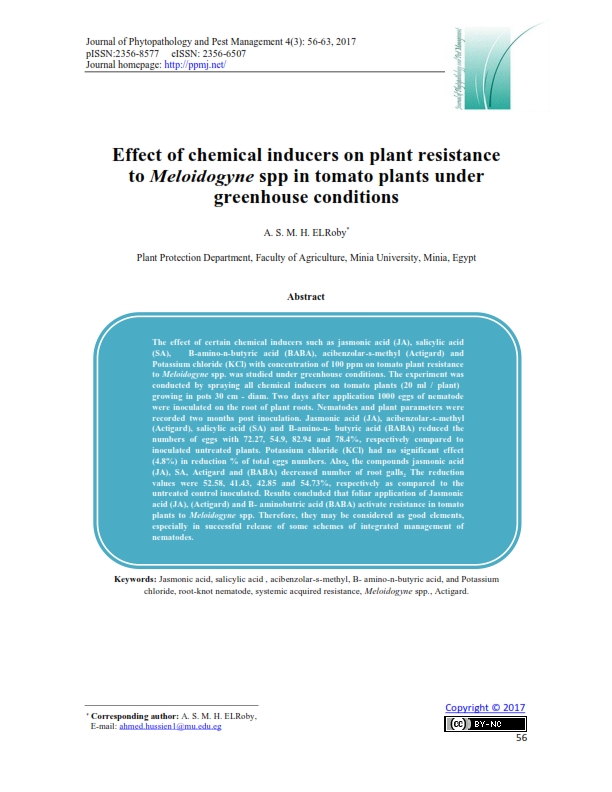
The effect of certain chemical inducers such as jasmonic acid (JA), salicylic acid (SA),  B-amino-n-butyric acid (BABA), acibenzolar-s-methyl (Actigard) and Potassium chloride (KCl) with concentration of 100 ppm on tomato plant resistance to Meloidogyne spp. was studied under greenhouse conditions. The experiment was conducted by spraying all chemical inducers on tomato plants (20 ml / plant) growing in pots 30 cm - diam. Two days after application 1000 eggs of nematode were inoculated on the root of plant roots. Nematodes and plant parameters were recorded two months post inoculation. Jasmonic acid (JA), acibenzolar-s-methyl (Actigard), salicylic acid (SA) and B-amino-n- butyric acid (BABA) reduced the numbers of eggs with 72.27, 54.9, 82.94 and 78.4%, respectively compared to inoculated untreated plants. Potassium chloride (KCl) had no significant effect (4.8%) in reduction % of total eggs numbers. Also, the compounds jasmonic acid (JA), SA, Actigard and (BABA) decreased number of root galls. The reduction values were 52.58, 41.43, 42.85 and 54.73%, respectively as compared to the untreated control inoculated. Results concluded that foliar application of Jasmonic acid (JA), (Actigard) and B- aminobutric acid (BABA) activate resistance in tomato plants to Meloidogyne spp. Therefore, they may be considered as good elements, especially in successful release of some schemes of integrated management of nematodes.
Références
Téléchargements
Publiée
Numéro
Rubrique
Licence
Click here for more information on Licensing policy
 Print ISSN: 3009-6111